|
GC3WKVE
 Gone With the Wind (Classic Movies)
Type: Mystery | Size: Large  | Difficulty:
  | Terrain:
  By: 3 Williams Kidz @ | Hide Date: 09/11/2012 | Status: Available Country: United States | State: Colorado Coordinates: N39° 00.242 W105° 00.871 | Last updated: 08/30/2019 | Fav points: 0 


The cache is NOT at the above coordinates, but you will drive past that point when going for this cache; if you approach from a different direction, you will be met with signs prohibiting entry. Pretty flat, easy walk/hike to this one; while there may be Yankees in Atlanta (!) there aren’t any big mountains. And if you can’t get this cache today, don’t worry about that now; you can worry about that tomorrow. After all – tomorrow is another day ! A larger sized ammo can, placed close to views of the Waldo Canyon burn scar -- reminiscent of how the southern culture was "Gone With the Wind". Many of us will miss the tremendous scenery and wonderful hikes in Waldo Canyon, Williams Canyon, and many other hiking areas that were devastated by the fire; but, no matter how the fire started, it is all part of the nature cycle for the forest. That is what the kids and I try to remember. 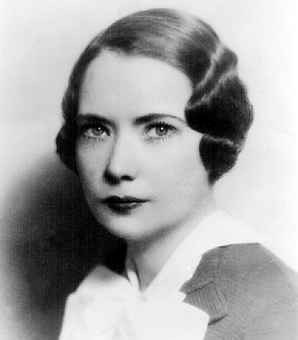 (Photo of Margaret Mitchell) BE SURE TO WRITE DOWN THE LETTER CODE ON THE LID OF THE CONTAINER, AND IN THE FRONT OF THE LOGBOOK (SAME CODE) WHICH IS USED IN THE “CLASSIC MOVIES" FINAL CACHE which is linked below.  Welcome to the tenth Classic Movies cache by the 3 Williams Kidz geo-team. The idea is that you will have to watch the movie to get the answers to the questions below; there are one, maybe two exceptions, for trivia’s sake. Since the entire script is available – and easily “searchable” -- online, I have tried to come up with questions that you cannot answer by searching the Internet, so some of these questions are pretty obscure. Here are all the geocaches in the Classic Movies series: 1. Casablanca 2. The Great Escape 3. The Good, the Bad and the Ugly 4. Cool Hand Luke 5. Patton 6. Butch Cassidy and the Sundance Kid 7. The Godfather 8. High Noon 9. The Wizard of Oz 10. Gone With the Wind And the FINAL cache: Classic Movies FINAL cache If you are willing to watch one of Hollywood’s finest classic movies, get the TV and video player ready, maybe pop some popcorn, and have a pen and paper ready to answer the below questions, which are NOT IN THE ORDER they are presented in the film (just one part of the difficulty rating). 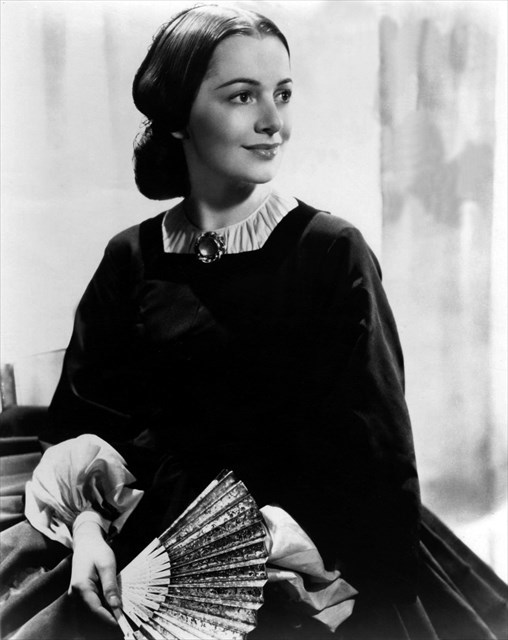 The cache is located at North AB CD.EFG West HIJ KL.MNO Latitude: A: The number of husbands Scarlett (Vivien Leigh) has throughout the film is A. B: Scarlett first tells Ashley (Leslie Howard) that she loves him in what room of the Twelve Oaks plantation mansion? If the kitchen, B=7. If the library, B=8. If the dining room, B=9. C: Melanie (Olivia DeHavilland) is having her baby; Prissy (Butterfly McQueen) goes to find Captain Butler (Clark Gable) -- and she finds him with Belle Watling (Ona Munson) in what establishment? If the Red Horse Saloon, C=5. If the Blue Parrot, C=0. D: Melanie is reading "David Copperfield" to the ladies; the highest number chapter of the book she gets to is D. E: Gerald O'Hara has passed away; on his marker, we can see the name of the county in Ireland where he was born. If the county is Donegal, E=0. If Cork, E=1. If Londonderry, E=2. If Wicklow, E=3. F: Ashley's party is over, and Scarlett has returned home, telling Mammy (Hattie McDaniel) that if Captain Butler asks for her, she is asleep. Just before she goes down the grand staircase and discovers Rhett, who is getting drunk -- VERY drunk -- we see that the time is quarter to WHAT hour? This hour is F. G: Scarlett does not convince Ashley to give up Melanie, and marry her instead; she slaps him, and he leaves the room. Frustrated, she picks up an object, and throws it across the room, where it smashes on the fireplace mantle, alarming Rhett Butler. What is the object? If it is a vase with three cherubs, G=4. If it is a platter, G=5. If it is a teapot, G=6. 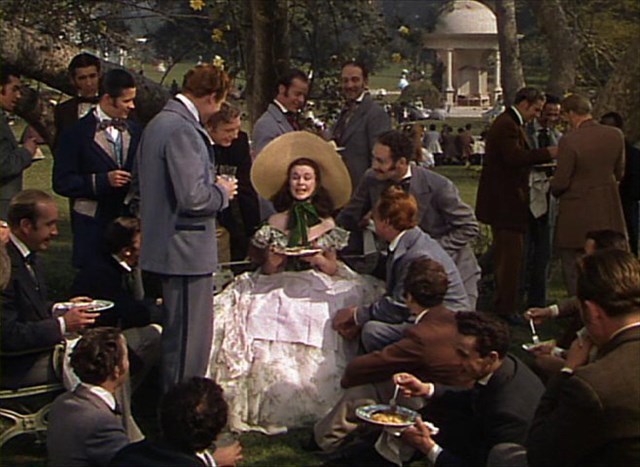 Longitude: H: Including Gone With the Wind, the number of novels written by Margaret Mitchell that were published while she was still alive is H. I: When Margaret Mitchell wrote the novel, she originally had a different name for Scarlett. If it was Pansy, I=0. If it was BethAnn, I=1. J: A written caption tells us home many days "The skies rained death …" and that for some number of days " … a battered Atlanta hung grimly on, hoping for a miracle …" The number of days has two digits, and the second digit is J. K: Gerald O'Hara (Thomas Mitchell), who is Scarlett's father, frequently calls Scarlett by her first and middle names; Scarlett is her middle name. What is her first name? If it is Katie, K=0. If it is Kristy, K=1. If it is Kathy, K=2. L: Gettysburg was a devastating defeat for the Confederacy. Casualty lists come out, and the band plays "Dixie". Pork (Oscar Polk) obtains one of the lists, and hands it to Scarlett and Melanie who are in a horse drawn buggy. Behind them, you can see the name of the local newspaper. If the paper is the Georgia Tribune, L=8. If it is the Southern Times, L=9. If it is the Atlanta Examiner, L=0. M: Scarlett and Rhett are on their honeymoon, aboard a paddlewheeler riverboat. Rhett is standing beside the bed, where Scarlett is resting. She is wearing an elaborate robe, and a bow in her hair. What color is the bow, which matches her robe? If it is green, M=9. If it is yellow, M=0. If it is blue, M=1. N: After speaking one of the most famous lines in movie history -- "Frankly my Dear, I don't give a damn.", Rhett walks off into the fog, puts his hat on his head, and can be seen carrying two things, which is all he takes with him. One is a suitcase. What is the other item? If it is a coat, N=8. If it is a second suitcase, N=9. If it is a picture of their daughter Bonnie (Cammie King Conlon), N=0. O: As we can see in a handwritten note, Maj. Ashley Wilkes is granted three days Christmas furlough. On the top of the letter, it says that this is a Special Orders, and the number has three digits. The first digit is O. 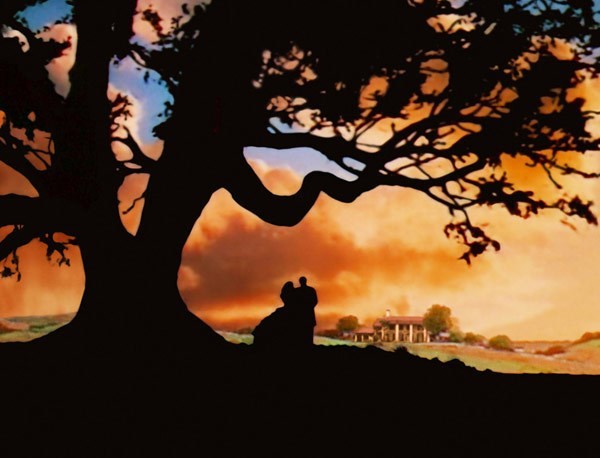 Hope you enjoyed the movie, and this puzzle ! If you have your solution, check it for accuracy at GeoChecker.com 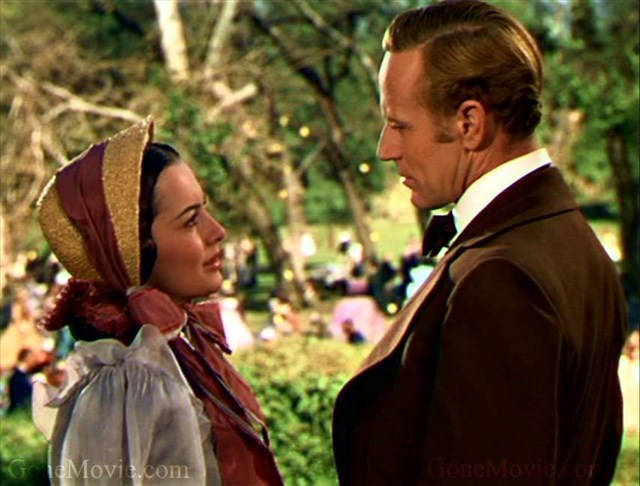 CONGRATULATIONS to estes01 and WingsAndTales for co-FTF on this difficulty 5 cache, in less than 24 hours of the cache being published -- including having to watch an almost-four-hour-long movie !!! 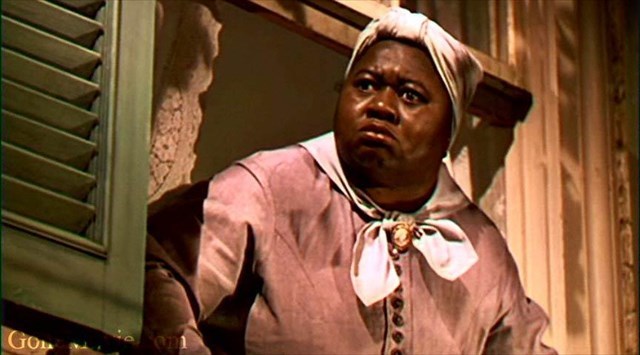 Some trivia, from The Internet Movie Database, at www.imdb.com: When Gary Cooper turned down the role for Rhett Butler, he was passionately against it. He is quoted saying both, "Gone with the Wind is going to be the biggest flop in Hollywood history," and, "I'm just glad it'll be Clark Gable who's falling on his face and not Gary Cooper." First color film to win the Best Picture Oscar. Olivia de Havilland was a contract player at Warner Brothers when MGM made the call to her for the part of Melanie. De Havilland was very keen to take the part and managed to convince her boss Jack L. Warner to let her out of her contract, mainly by getting his wife to exert her influence. Half a million feet of film were shot. This was all edited down to 20,000 feet. Leslie Howard privately felt that he was much too old to play Ashley Wilkes (the character was supposed to be about 21 at the start of the film). He wore extra make-up and a hairpiece to make him appear younger. Selznick was only able to persuade him to take the part by offering him a producer credit on Intermezzo: A Love Story. There are more than 50 speaking roles and 2,400 extras in the film. For the premiere in Atlanta in December 15, 1939, the governor declared a state holiday. Ticket prices for the premiere were 40 times the usual going rate. The only four actors David O. Selznick ever seriously considered for the role Rhett Butler were Clark Gable, Gary Cooper, Errol Flynn and Ronald Colman. The chief impediment to Gable's casting was his MGM contract. Gable was not drawn to the material; he didn't see himself in a period production, and didn't believe that he could live up to the public's anticipation of the character. Eventually, he was persuaded by a $50,000 bonus which would enable him to divorce his second wife Maria ("Ria") and marry Carole Lombard. All four principal characters appear together in the same scene only once, after the raid on Shantytown, when Rhett tells the anxious group of the fate of Scarlett's second husband, Frank Kennedy. To portray Melanie, Olivia de Havilland spent most of the film in drab, dowdy costumes. She wore 2 elaborate dresses in the film: one when Melanie and Ashley announce their engagement, and a striking blue taffeta dress that Melanie wears to Scarlett's first wedding. Unfortunately, due to film aspect ratio at the time (long before the advent of widescreen), the screen could not accommodate two dresses built up with hoop skirts, so they had to be removed. Thus, de Havilland's rare appearance in a beautiful dress was shot from the waist up, with the skirt hanging limp. In 1939, the Hollywood Production Code dictated what could and could not be shown or said on screen, and Rhett Butler's memorable last line presented a serious problem. A few of the suggested alternatives were "Frankly my dear... I just don't care," "... it makes my gorge rise," "... my indifference is boundless," "... I don't give a hoot," and "... nothing could interest me less." Although legend persists that the Hays Office fined Selznick $5,000 for using the word "damn", in fact the Motion Picture Association board passed an amendment to the Production Code on November 1, 1939, to insure that Selznick would be in compliance with the code. Henceforth, the words "hell" and "damn" would be banned except when their use "shall be essential and required for portrayal, in proper historical context, of any scene or dialogue based upon historical fact or folklore ... or a quotation from a literary work, provided that no such use shall be permitted which is intrinsically objectionable or offends good taste." With that amendment, the Production Code Administration had no further objection to Rhett's closing line, "Frankly, my dear, I don't give a damn." 1,400 actresses were interviewed for the part of Scarlett O'Hara. 400 were asked to do readings. Judy Garland was the leading contender for the role of Scarlett's sister Carreen before her "Andy Hardy" series co-star Ann Rutherford was cast, but she was tied up with commitments to another film directed by Victor Fleming: The Wizard of Oz. Ironically, Fleming would replace George Cukor on both The Wizard of Oz and Gone with the Wind. One month after the book was published, David O. Selznick purchased the movie rights from Margaret Mitchell for an unprecedented $50,000. At the time it was the highest sum that had ever been paid for an author's first novel. Realizing he had underpaid Mitchell, Selznick gave her an additional $50,000 as a bonus when he dissolved Selznick-International Pictures in 1942. The premiere was held in Atlanta, Georgia on December 15, 1939. It was reportedly the first time that David O. Selznick had been in the South. Margaret Mitchell was dismayed at the scale of the Tara and Twelve Oaks sets, writing to her friend, technical advisor Susan Myrick, "I grieve to hear that Tara has columns. Of course, it didn't and looked nice and ugly like Alex Stephens' Liberty Hall [in Crawfordville, Georgia]." And, "I had feared, of course that [Twelve Oaks] would end up looking like the Grand Central Station, and your description confirms my worst apprehensions. I did not know whether to laugh or to throw up at the TWO staircases.... God help me when the reporters get me after I've seen the picture. I will have to tell the truth, and if Tara has columns and Twelve Oaks is such an elegant affair I will have to say that nothing like that was ever seen in Clayton County, or, for that matter, on land or sea.... When I think of the healthy, hardy, country and somewhat crude civilization I depicted and then of the elegance that is to be presented, I cannot help yelping with laughter... " The first scene to be shot was the burning of the Atlanta Depot, filmed on 10 December 1938. If there was a major mistake during the filming, the entire film might have been scrapped. They actually burned many old sets that needed to be cleared from the studio backlot, including sets from The Garden of Allah and the "Great Wall" set from King Kong. The fire cost over $25,000, and yielded 113 minutes of footage. It was so intense that Culver City residents jammed the telephones lines, thinking MGM was burning down. Scarlett was stunt doubled by Aline Goodwin and Lila Finn, while Rhett was doubled by veteran stuntmen Yakima Canutt and Jay Wilsey. The film has never been cut. Recent releases are longer because of the added Overture, intermission, and exit music, not because any deleted scenes have been restored. Very few of the principal cast members liked the characters they were portraying. Clark Gable was induced into accepting his role through arrangements to divorce his current wife and marry Carole Lombard. Rand Brooks, who played Scarlett's first husband, Charles Hamilton, was actually a rough outdoors-man who objected to playing a wimpy character. Butterfly McQueen disliked the negative stereotype of her character. Leslie Howard felt he was too old for the role of Ashley Wilkes and complained that his costumes made him look like "a fairy doorman" at a hotel. David O. Selznick begged Margaret Mitchell, author of the novel, to critique every aspect of the production. An intensely private person, Mrs. Mitchell gave one criticism of the facade of the design for Tara, which was ignored. Afterward, she refused to comment on any aspect of the film during production. In the scene where Scarlett searches for Dr. Meade, making her way among 1,600 suffering and dying Confederate soldiers, to cut costs and still comply with a union rule that dictated the use of a certain percentage of extras in the cast, 800 dummies were scattered among 800 extras. The crane shot where Scarlett searches for Dr. Meade, making her way among suffering and dying Confederate soldiers, was Val Lewton's idea. He had previously been Selznick's assistant editor and went on to produce a string of B movies though the 1940s. All seven of Hollywood's then-existing Technicolor cameras were used to film the Burning of the Atlanta Depot. Flames 500 feet high leaped from a set that covered 40 acres. Ten pieces of fire equipment from the Los Angeles Fire Department, 50 studio firemen and 200 studio helpers stood by throughout the filming of this sequence in case the fire should get out of hand. Three 5,000-gallon water tanks were used to quench the flames after shooting. Female costumes were made complete with petticoats, although they wouldn't have been missed had they not been there. In the scene after Scarlett returns to a decimated Tara, digs up a radish in the garden, then retches and gives her famous "As God is my witness... " line, the vomiting sounds were actually looped by Olivia de Havilland. One version of the story is that Vivien Leigh "could not" produce a convincing enough retching sound. Another version of the story is that Vivien Leigh "would not" make the retching sound because "it simply was not lady-like". Vivien Leigh worked for 125 days and received about $25,000. Clark Gable worked for 71 days and received over $120,000. The film sequence that is commonly referred to as "the Burning of Atlanta" was not the actual burning of the city by General Sherman in November 1864. Instead, the scene represents the night, two months earlier, when the retreating Confederate army torched its ammunition dumps to keep the Union army from capturing them. Clark Gable was so distressed over the requirement that he cry on film (during the scene where Melanie is comforting Rhett after Scarlett's miscarriage) that he almost quit. Olivia de Havilland convinced him to stay. The horse that Thomas Mitchell rode was later Silver of The Lone Ranger fame. Hattie McDaniel became the first African-American to be nominated for, and win, an Academy Award. Mickey Kuhn, who played Vivien Leigh's nephew Beau Wilkes, also played the young sailor who helps her onto the streetcar in A Streetcar Named Desire. When Kuhn mentioned to someone else on the set that he had acted with Leigh as a child, word got back to her and she called him into her dressing room for a half-hour chat. In an interview in his seventies, Kuhn stated that Leigh was extremely kind to him and "one of the loveliest ladies he had ever met." The reminiscent wounded soldier in the makeshift Atlanta hospital talking to nurses Scarlett and Melanie about his "brother Jeff" was played by Cliff Edwards. Edwards later provided the voice of Jiminy Cricket in Walt Disney's classic Pinocchio and introduced the Academy Award winning song "When You Wish Upon A Star". Edwards is only heard, not seen, as the reminiscent solder in Gone with the Wind. When Melanie says that Bonnie's eyes are "as blue as the 'Bonnie Blue' flag", she is referring to the popular name of the single-star secession flag that was flown over Georgia after it seceded from the union (as well as over all other states that did so). Is consisted of a single white star over a field of blue. Tradition holds that it flew over Georgia for the first few months of 1861 before being replaced by the better-known "Stars And Bars" Confederate flags of later years. Barbara O'Neil was only 28 when she appeared as Ellen O'Hara (Scarlett's mother). Vivien Leigh was 25 when she appeared as Scarlett, who is only 16 at the beginning of the film. At nearly four hours long, this is longest running of all movies to win the Best Picture Academy Award. The character of Ashley Wilkes was based on Margaret Mitchell's cousin by marriage John "Doc" Holliday. Melanie was based on Mitchell's third-cousin, and Doc's first cousin and close friend, Mattie "Sister Melanie" Holliday. Doc moved West and became the gambler and gunfighter we know. Mattie joined a convent and became a nun, but maintained a correspondence with Doc. The character of Rhett Butler was partially inspired by Mitchell's husband nicknamed "Red", to whom she had a short and passionate marriage. Rhett Butler's initials on the handkerchief given to Melanie by Belle are "R.B." or "R.K.B." in the novel, which were the same as Red's- only rearranged. During filming Vivien Leigh reportedly smoked four packets of cigarettes a day. Clark Gable smoked three packs a day throughout his career. Sidney Howard's screen writing Oscar was the Academy's first posthumous award. Howard died in an accident in August 1939 while the Civil War epic was still being filmed. Clark Gable disliked this, his most famous film, which he regarded as "a woman's picture." The entr'acte music is played entirely on a Novachord, the first use of an electronic synthesizer in a Hollywood feature film. Ann Rutherford got the call at 3:00am to be on location to pick cotton for a scene. She was licking the blood off her fingers when picking the cotton. David O. Selznick came by to check on her. She showed him the blood. He said, "Good! Good!". Three of the four principal actors, Leslie Howard, Vivien Leigh, and Clark Gable, died at relatively young ages. Olivia de Havilland is the only one who remains alive as of this writing. Ironically, her character is the only one who dies in the film. Additional Waypoints
Add cache to watch list Log your visit Picture Gallery
Base of two aspens and one pine tree, all within a few feet of each other.
GC7C8HA Stalin's Gambit (19.03 kms N) GCY91R The Phone's Broke (23.67 kms SW) GC7C8BX Lincoln Mountain Thunderbirds (29.08 kms NE) GC6RY05 Cheyenne Mountain Peak (31.87 kms S) GC3WMD8 L49's - USMC Navy Cross (60.39 kms N) |
Driving Directions
5 Logs:
GeoWoodstock XVII Ft. Worth, TX May 25, 2019 10:00AM - 5:00PM https://coord.info/GC7NBWQ It is on the way to Giga status, so please log a "will attend" if you are coming.
|
 5
5