Part of a series sharing historical information about the Pikes Peak backcountry placed by the Pikes Peak Historical Society.
The coordinates above are for the actual cache. You can find the coordinates for the prayer tree at the waypoint listed.

Throughout traditional Ute ancestral lands, hundreds of culturally scarred trees have been identified. In the Pikes Peak area, these have been mapped and recorded by the Pikes Peak Historical Society, the Florissant Fossil Beds National Monument, Sanborn Western Camps/The Nature Place and independent experts such as archaeologist Marilyn A. Martorano.
These culturally scarred trees are of several different types: (1) the Peeled Bark, or Medicine Trees, (2) the Bent or Prayer Trees, (3) arborglyphs or Message Trees, and (4) burial markers or Burial Trees.
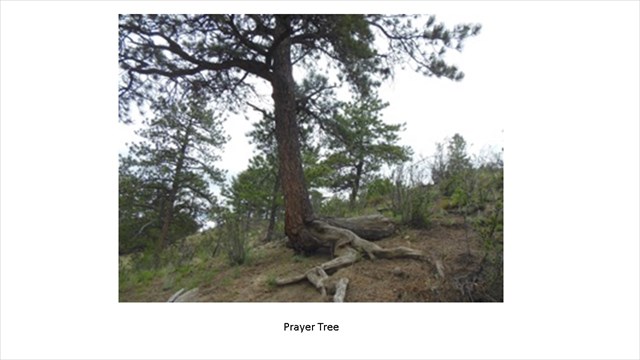
You are at the site of a Ute culturally scarred tree called a Prayer Tree. These trees are used for ceremony. A young sapling, usually a ponderosa, was selected by the Medicine Man and bent parallel to the ground where it was tied with a yucca rope. When it is tied it leaves a ring of scarring in the tree trunk and is visible and evident that a human being made the tie. This is clearly visible in this prayer tree and is one of the ways you can tell the tree was not the result of a lightning strike. At the ceremony, all the Ute people circled the tree, offered tobacco, and prayed. They believed that the tree would live and hold their prayers for 800 years and each breeze would give their prayers new breath. This particular prayer tree marks this hill as a sacred Vision Quest site.
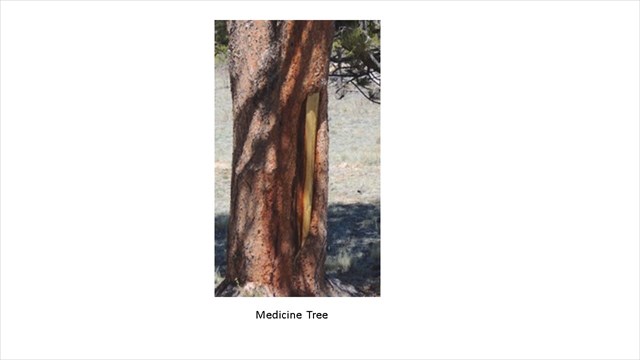
Here is an example of a medicine tree. For a more detailed report on culturally scarred trees you can go to the Pikes Peaks Historical Society web site at pikespeakhsmuseum.org. Choose the "History" tab then the "Indians" tab.
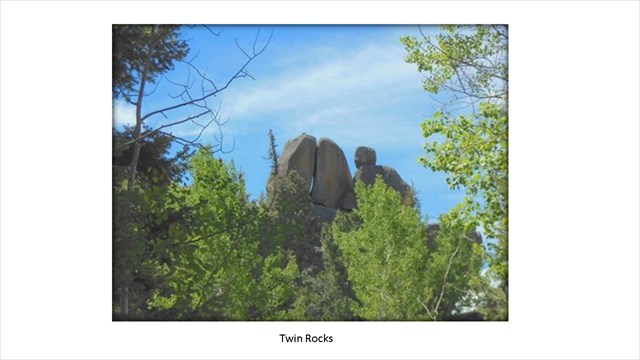
To the east of the library, on the crest of the hill is a prominent landmark used by the Ute Indians and by early pioneers. We call it Twin Rocks, but the Ute referred to it as “Los Ojos Ciegos” or the Blind Eyes. This is in reference to the Ute legend when Coyote tosses his eyes up too many times, in violation of a warning from the chickadees, and his eyes remained hanging in the trees (pine cones).
The wide valley to the south and west of the Prayer Tree is part of the Florissant Fossil Beds National Monument. This valley is probably where the Spanish army encamped in 1779 while on a campaign against the Comanche. They were led by 200 Ute warriors/scouts. The Ute Indians referred to the Fossil Beds as “Valley of the Shadows.” This referred to the 35 million-year-old fossils entombed in the ash by the Guffey volcano. It was thought that the shadow of the plants, insects and animals held their spirit.
Additional Waypoints
R06G26H - Prayer Tree
N 38° 56.654 W 105° 16.778
 PPHS Prayer Tree
 | Difficulty:
  | Terrain:


 9
9  1
1